Particle (Basic ㊦ 90)
A sentence final particle which indicates an interrogative word question in informal male speech.
| (1) {Adjective な stem/ N} | だい | |
| 静かだい | Something is quiet? | |
| 先生だい | Someone is a teacher? | |
| (2) {V/Adjective い} informal | んだい | |
| {話す/話した} んだい | Someone talks/talked? | |
| {高い/高かった} んだい | Something is/was expensive? | |
| (3) {Adjective な stem/ N} | {な/だった} んだい | |
| {静かな/ 静かだった} んだい | Something is/was quiet? | |
| {先生な/先生だった} んだい | Someone is/was a teacher? |
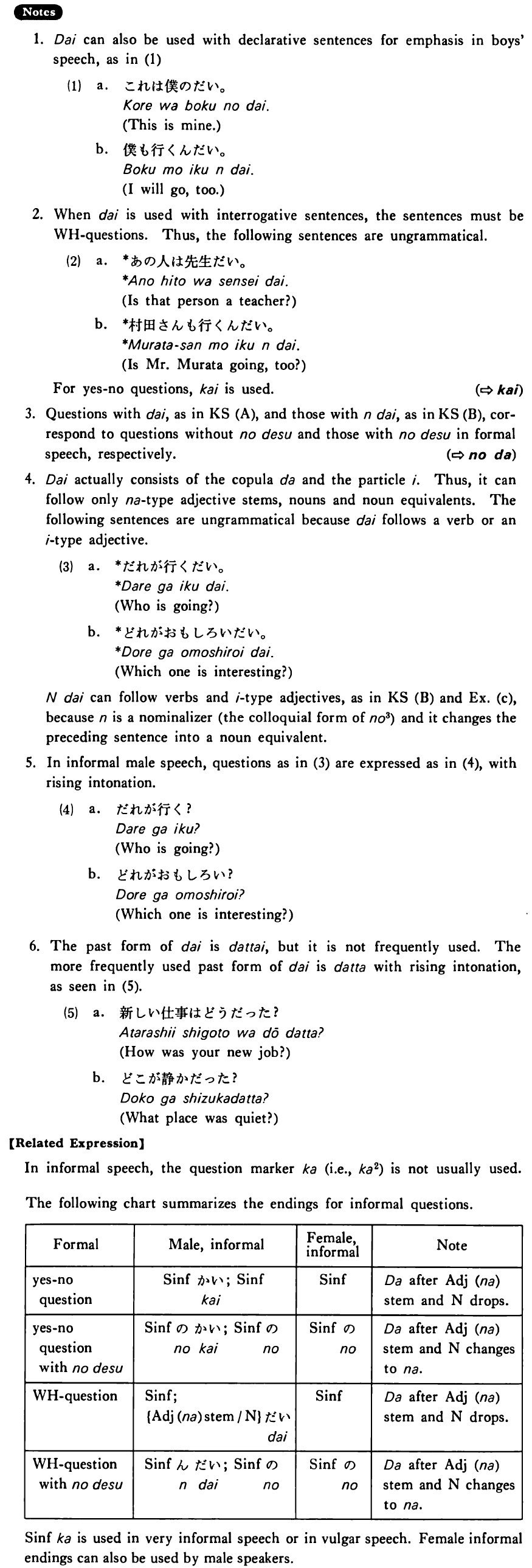
1. だい can also be used with declarative sentences for emphasis in boys' speech, as in (1)
2. When だい is used with interrogative sentences, the sentences must be interrogative word questions. Thus, the following sentences are ungrammatical.
For yes-no questions, かい is used.
(⇨ かい)
3. Questions with だい, as in Key Sentence (A), and those with んだい, as in Key Sentence (B), correspond to questions without のです and those with のです in formal speech, respectively.
(⇨ のだ)
4. だい actually consists of the copula だ and the particle い. Thus, it can follow only な type adjective stems, nouns and noun equivalents. The following sentences are ungrammatical because だい follows a verb or an い type adjective.
5. In informal male speech, questions as in (3) are expressed as in (4),with rising intonation.
6. The past form of だい is だったい, but it is not frequently used. The more frequently used past form of だい is だった with rising intonation, as seen in (5).
【Related Expression】
In informal speech, the question marker か (i.e., か2) is not usually used.
The following chart summarizes the endings for informal questions.
| Formal | Male, informal | Female, informal | Note |
| yes-no question | Sentence informalかい | Sentence informal | だ after Adjectiveな stem and ん drops |
| yes-no question with のです | Sentence informalのかい | Sentence informalの | だ after Adjectiveな stem and ん changes to な |
| Interrogative word question | Sentence informal; {Adjectiveなstem/Noun}だい | Sentence informal | だ after Adjectiveな stem and ん drops |
| Interrogative word question with のです | Sentence informalんだい | Sentence informalの | だ after Adjectiveな stem and ん changes to な |
Sentence informalか is used in very informal speech or in vulgar speech. Female informal endings can also be used by male speakers.